
The Preserving Paradise program empowers business leaders to champion Everglades restoration and protect the region’s economic vitality through clean water advocacy.
By Stephanie Granada
When I joined the inaugural class of Preserving Paradise in 2024, I thought I already understood the stakes of Florida’s water story. Working in media, I’ve dug into hurricanes, red-tide blooms and the politics of restoration. But being part of the program shifted me from knowing about it to being inside it. Through classrooms, boat rides and field tours, 23 of us got to see how deep the story goes—and the power we all have to influence what happens next.
Launched by Captains For Clean Water, the Sanibel & Captiva Islands Chamber of Commerce, the Sanibel-Captiva Conservation Foundation (SCCF) and the Everglades Foundation, Preserving Paradise brings together business and community leaders to learn about the science and policy behind Florida’s most defining resource: water. Participants immerse themselves in the hydrology of the Everglades, the economics of clean water and the ripple effects of environmental policy.
Over the course of three months and seven sessions, we became students again. The first day opened with Everglades Foundation CEO Eric Eikenberg walking us through decades of decisions that reshaped Florida’s ecosystem: the draining of the swamp, the redirection of rivers, the unintended consequences that still play out every rainy season.
I was intrigued to learn that a 1981 Sports Illustrated story, titled “There’s Trouble in Paradise,” played a pivotal role in bringing the Everglades ecological crisis to the forefront. The story moved then-Governor Bob Graham to launch the state’s first major restoration initiatives. It reminded me that sharing stories—whether we’re journalists or not—is one of the most powerful tools we have to inspire action. That’s the energy Preserving Paradise channels: empowering leaders from every sector to learn the science, see the impact and bring those stories back to their own networks.

Between field visits, we met in conference rooms around Fort Myers Beach and Sanibel for classroom sessions led by policy experts and conservation scientists. We discussed nutrient pollution, Everglades restoration timelines and the importance of coalition building. Around the table were hotel owners, architects, restaurateurs, bankers and small-business operators.
Tim Collier, a fifth-generation Floridian and co-owner of Big Nick’s Barbecue, spoke about seeing the fisheries change over his lifetime; others shared stories of canceled charters, flooded job sites and guests who never rebooked after a red-tide outbreak. Each story drew the same conclusion: clean water shapes every industry that calls this coast home.
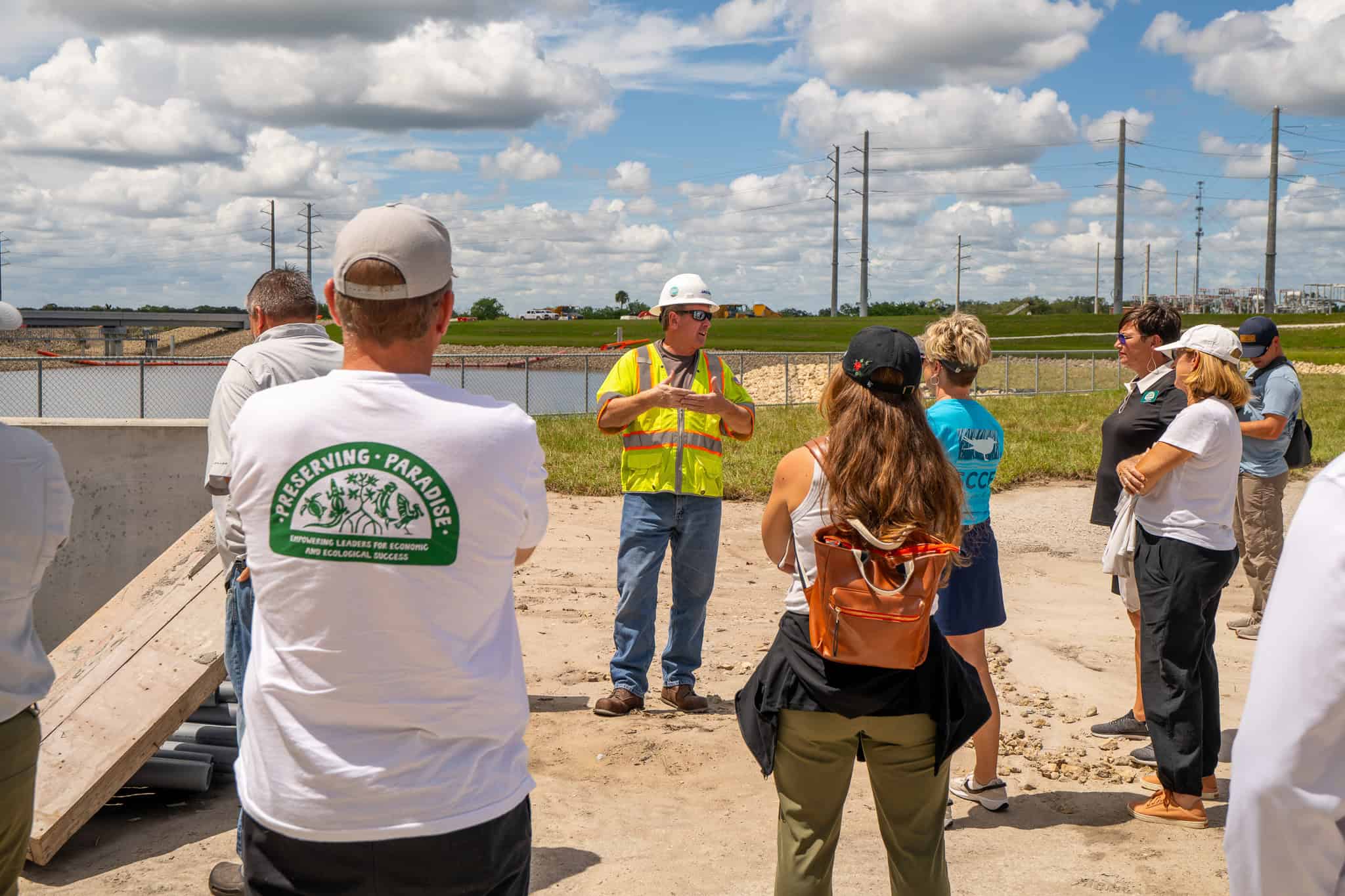
The day we went out fishing with a guide around Pine Island Sound, the water was blue and glassy with a silted, tea-stained undertone—a mix of natural tannin-rich flow and sediment-laden runoff pressed out of the watershed. Hearing the captain talk about his experience over the past decade, it was clear how much the balance here depends on what happens inland, on decisions made miles away that determine what flows into these estuaries and when. A few weeks later, standing inside one of the Everglades Agricultural Area Reservoir pump stations, the group witnessed restoration at scale: the massive infrastructure that is starting to send water south as nature intended for the first time in a century.
What Preserving Paradise makes clear is that, along the coast, water issues and business issues are the same conversation. Clean water fuels the tourism economy, sustains property values, supports recreation and real estate, and underpins the very identity of this coast. Yet while industries like corporate agriculture and sugar have long operated as unified forces in policy debates, the independent business community hasn’t rallied in the same way. This program changes that by creating shared understanding and responsibility among people who might otherwise operate in parallel.
For me, the experience underscored two simple truths. One: the water that defines this place defines our future. Protecting it isn’t a niche cause or a partisan issue. It’s an act of stewardship that sustains every dock, dining room and shoreline view that makes this place special. Two: telling the story keeps the work moving. The 1981 article changed Florida’s trajectory. Preserving Paradise expands the network of informed Everglades champions.
The River of Grass may span more than 200 mighty miles, but its protection begins with individual awareness and leadership. And in that sense, the tide is already turning.
To learn more about the Preserving Paradise program, and how to apply for the Fall 2026 cohort, check out this page.
The Preserving Paradise program empowers business leaders to champion Everglades restoration and protect the region’s economic vitality through clean water advocacy.
By Stephanie Granada
When I joined the inaugural class of Preserving Paradise in 2024, I thought I already understood the stakes of Florida’s water story. Working in media, I’ve dug into hurricanes, red-tide blooms and the politics of restoration. But being part of the program shifted me from knowing about it to being inside it. Through classrooms, boat rides and field tours, 23 of us got to see how deep the story goes—and the power we all have to influence what happens next.
Launched by Captains For Clean Water, the Sanibel & Captiva Islands Chamber of Commerce, the Sanibel-Captiva Conservation Foundation (SCCF) and the Everglades Foundation, Preserving Paradise brings together business and community leaders to learn about the science and policy behind Florida’s most defining resource: water. Participants immerse themselves in the hydrology of the Everglades, the economics of clean water and the ripple effects of environmental policy.
Over the course of three months and seven sessions, we became students again. The first day opened with Everglades Foundation CEO Eric Eikenberg walking us through decades of decisions that reshaped Florida’s ecosystem: the draining of the swamp, the redirection of rivers, the unintended consequences that still play out every rainy season.
I was intrigued to learn that a 1981 Sports Illustrated story, titled “There’s Trouble in Paradise,” played a pivotal role in bringing the Everglades ecological crisis to the forefront. The story moved then-Governor Bob Graham to launch the state’s first major restoration initiatives. It reminded me that sharing stories—whether we’re journalists or not—is one of the most powerful tools we have to inspire action. That’s the energy Preserving Paradise channels: empowering leaders from every sector to learn the science, see the impact and bring those stories back to their own networks.
Between field visits, we met in conference rooms around Fort Myers Beach and Sanibel for classroom sessions led by policy experts and conservation scientists. We discussed nutrient pollution, Everglades restoration timelines and the importance of coalition building. Around the table were hotel owners, architects, restaurateurs, bankers and small-business operators.
Tim Collier, a fifth-generation Floridian and co-owner of Big Nick’s Barbecue, spoke about seeing the fisheries change over his lifetime; others shared stories of canceled charters, flooded job sites and guests who never rebooked after a red-tide outbreak. Each story drew the same conclusion: clean water shapes every industry that calls this coast home.
The day we went out fishing with a guide around Pine Island Sound, the water was blue and glassy with a silted, tea-stained undertone—a mix of natural tannin-rich flow and sediment-laden runoff pressed out of the watershed. Hearing the captain talk about his experience over the past decade, it was clear how much the balance here depends on what happens inland, on decisions made miles away that determine what flows into these estuaries and when. A few weeks later, standing inside one of the Everglades Agricultural Area Reservoir pump stations, the group witnessed restoration at scale: the massive infrastructure that is starting to send water south as nature intended for the first time in a century.
What Preserving Paradise makes clear is that, along the coast, water issues and business issues are the same conversation. Clean water fuels the tourism economy, sustains property values, supports recreation and real estate, and underpins the very identity of this coast. Yet while industries like corporate agriculture and sugar have long operated as unified forces in policy debates, the independent business community hasn’t rallied in the same way. This program changes that by creating shared understanding and responsibility among people who might otherwise operate in parallel.
For me, the experience underscored two simple truths. One: the water that defines this place defines our future. Protecting it isn’t a niche cause or a partisan issue. It’s an act of stewardship that sustains every dock, dining room and shoreline view that makes this place special. Two: telling the story keeps the work moving. The 1981 article changed Florida’s trajectory. Preserving Paradise expands the network of informed Everglades champions.
The River of Grass may span more than 200 mighty miles, but its protection begins with individual awareness and leadership. And in that sense, the tide is already turning.