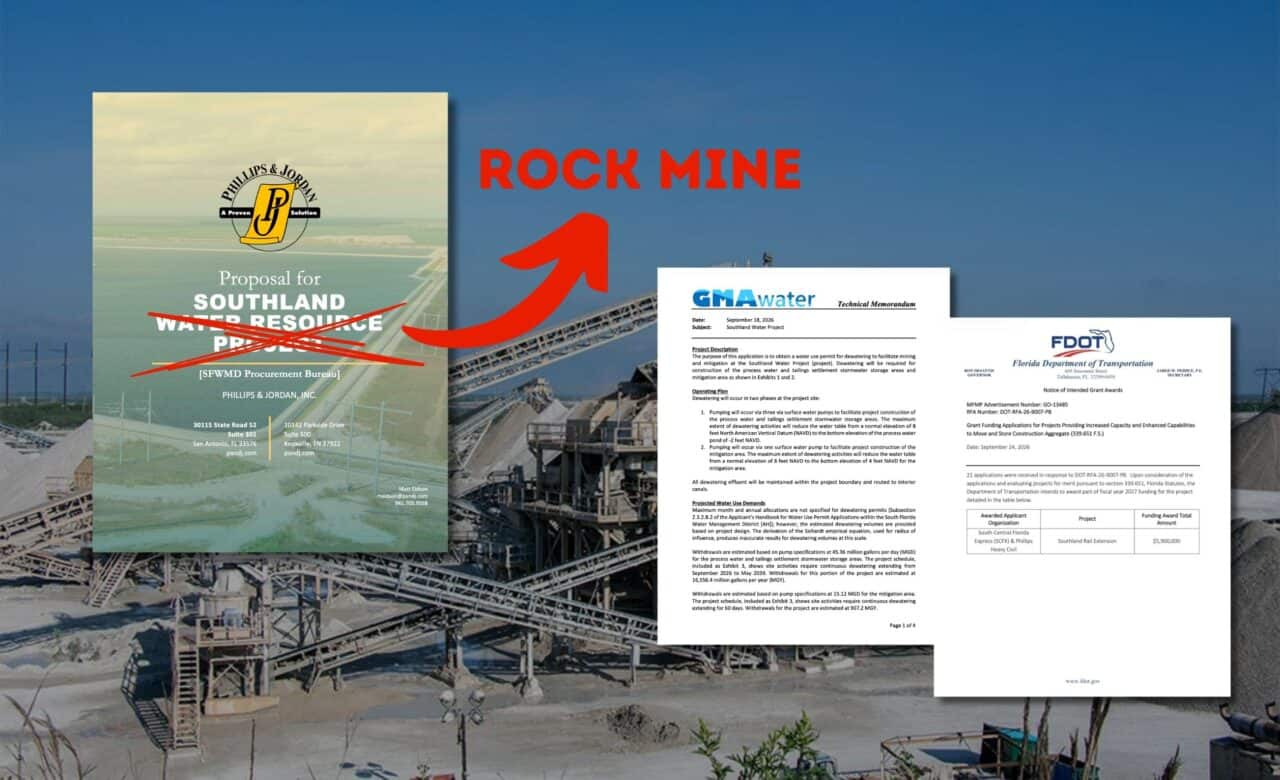
After repeated delays, a massive new mining-related permit application, and a proposed $5.9 million taxpayer-funded rail extension, serious questions are mounting about Southland's so-called water-resource project.
For more than two years, Big Sugar and the interests behind the proposed Southland Rock Mine have been selling the project as a solution for Florida's water challenges. They've promoted its potential water-storage benefits, suggested it would complement Everglades restoration, and assured the public that the project wouldn't strain public resources.
But the deeper we dig into the records, the harder those claims are to reconcile with what's actually happening.
In just the past few weeks, Southland has received yet another extension to answer fundamental questions about its supposed water-resource benefits, submitted a detailed application for long-term dewatering associated with mining operations, and been named in a $5.9 million intended state grant award for railroad infrastructure.
All while proposing a massive mining operation right next to one of the most important Everglades restoration projects in history.
So what's really going on?
First, a quick refresher: What is Southland?
The Southland proposal involves approximately 8,600 acres of agricultural land owned by interests associated with U.S. Sugar and Florida Crystals, immediately adjacent to the Everglades Agricultural Area (EAA) Reservoir and Stormwater Treatment Area.
The project is being advanced by Phillips and its affiliates, under the premise of creating a privately developed water-storage project.
But there's another major component: excavating, aka mining, enormous quantities of limestone, processing that material, and transporting it out by rail.
And the location couldn't be more concerning.
Southland sits roughly 1,000 feet from the $4 billion EAA Reservoir project currently under construction, the crown jewel of Everglades restoration. For perspective, that's roughly the distance a skiff traveling at 30 mph would cover in just 23 seconds.
The EAA Reservoir is designed to capture excess water from Lake Okeechobee, clean it through an adjacent treatment area, and send more clean freshwater south to the Everglades and Florida Bay. It's a critical piece of a decades-long effort to restore the natural flow of water through South Florida.
Placing a massive industrial mining operation next door raises serious concerns about potential impacts to that investment.
The U.S. Army Corps of Engineers has already raised concerns about seepage and how mining activities could affect the nearby reservoir and treatment area.
Yet Southland's backers continue to promote the project as a beneficial addition to Florida's water-management system.
Here's what the latest records tell us.
1. They call it a water-resource project. So why can't they answer the water-resource questions?
When the South Florida Water Management District (SFWMD) began evaluating Southland's unsolicited water-resource proposal, it requested information necessary to determine whether the project could actually deliver the public benefits being promised.
Those questions involve fundamental issues like water-storage capacity, water quality, public benefits, and potential impacts to surrounding water resources.
That was back in April 2025.
Since then, Southland's backers have repeatedly asked for more time to provide the information.
Four extension requests, totaling approximately 461 days of additional time.
The latest request came recently on September 25, 2026. Three days later, the District granted another extension, pushing the deadline to December 1.
Nearly two years after the current proposal was submitted, the District is still waiting for the revised information it needs to complete its evaluation of the water-resource component.
View this post on Instagram
But here's where things get interesting.
Just one day after that latest extension was granted, Southland filed an entirely separate application with the District.
This time, the plans were remarkably specific.
On September 29, Phillips submitted an application for a long-term dewatering permit. The accompanying technical memorandum explicitly identifies the purpose as facilitating "mining and mitigation."
The application outlines:
- Pumping capacity of up to 45.36 million gallons of water per day for the primary dewatering operation.
- Plans to lower the water table by as much as 10 feet in the primary dewatering area.
- A requested permit extending through December 2039.
- Detailed schedules for excavation, blasting, rock crushing, processing, rail infrastructure, and mining operations.
To put that pumping capacity into perspective, 45 million gallons is roughly the equivalent of an Olympic-sized swimming pool every 21 minutes.
And this is proposed immediately adjacent to a multibillion-dollar Everglades restoration project.
So, the contrast between what Southland says and what Southland does is getting harder to ignore.
While they continue requesting extensions to explain how the project will deliver public water-resource benefits, their mining-related plans are laid out in extraordinary detail.
Two Very Different Stories.
Why does the mining side appear ready to move forward while the supposed public water-resource benefits remain unresolved?
And if the proposed water-storage component never materializes, what happens to the mine?
Those are questions the public deserves answers to.
2. They said the project wouldn't strain public resources. Now there's a $5.9 million state grant in the picture.
From the beginning, Southland's backers have emphasized the privately funded nature of their proposed project.
Among the assurances offered was that the project would be developed without straining public resources.
But a recently uncovered document raises serious questions about that promise.
On September 24, 2026, the Florida Department of Transportation issued a Notice of Intended Grant Awards, identifying South Central Florida Express and Phillips Heavy Civil as recipients of a proposed $5.9 million award for the Southland Rail Extension.
In other words, public funding for rail infrastructure associated with moving the material produced by the proposed mining operation.
The notice is an intended award, not confirmation that funding has already been disbursed. But it establishes that the project was selected for a proposed multimillion-dollar state grant.
That creates an obvious question:
If Southland was supposed to move forward without straining public resources, why is taxpayer funding now being sought for infrastructure associated with its mining operation?
There's also a broader issue worth examining.
The proposed water-storage component remains under District evaluation, yet state transportation funding has already been proposed for infrastructure supporting the movement of aggregate.
Once again, the mining-related components appear to be moving forward while the supposed public water benefits remain uncertain.
And the $5.9 million rail award could be just the beginning. That's basically just money for the driveway to the project. Who knows how much more taxpayer funding they will seek for the actual project?
View this post on Instagram
View the FDOT September 24 Notice of Intended Grant Awards
3. They say the project will complement Everglades restoration. The Army Corps has raised serious concerns.
Southland's backers have repeatedly presented the project as complementary to Everglades restoration, with assurances that its mining activities would not negatively affect nearby restoration infrastructure.
But federal water managers have raised significant concerns.

Construction of the EAA Reservoir.
In July 2025, the U.S. Army Corps of Engineers acknowledged concerns about the proposal, including the possibility that seepage associated with mining activities could affect the EAA Reservoir and its adjacent Stormwater Treatment Area.
Those concerns are especially relevant now.
Southland's newly submitted dewatering application proposes lowering groundwater levels during construction activities immediately north of the A-2 Stormwater Treatment Area.
The applicant's technical analysis concludes that the potential for certain off-site impacts is minimal, citing site hydrology, existing canals, and proposed water-management measures.
But those conclusions need thorough independent scrutiny, particularly given the proximity to federally authorized restoration infrastructure.
We're talking about billions of public dollars invested in a project designed to restore the Everglades, reduce damaging Lake Okeechobee discharges, and protect Florida's coastal communities.
The risks are too significant to simply accept assurances at face value.
We took these concerns directly to the Governing Board
On October 8, Captains For Clean Water brought these latest developments directly to the South Florida Water Management District's Governing Board.
Two members of our team spoke during the meeting, raising questions about the repeated extensions, the new dewatering permit application, and the disconnect between Southland's detailed mining plans and its still-incomplete water-resource proposal.
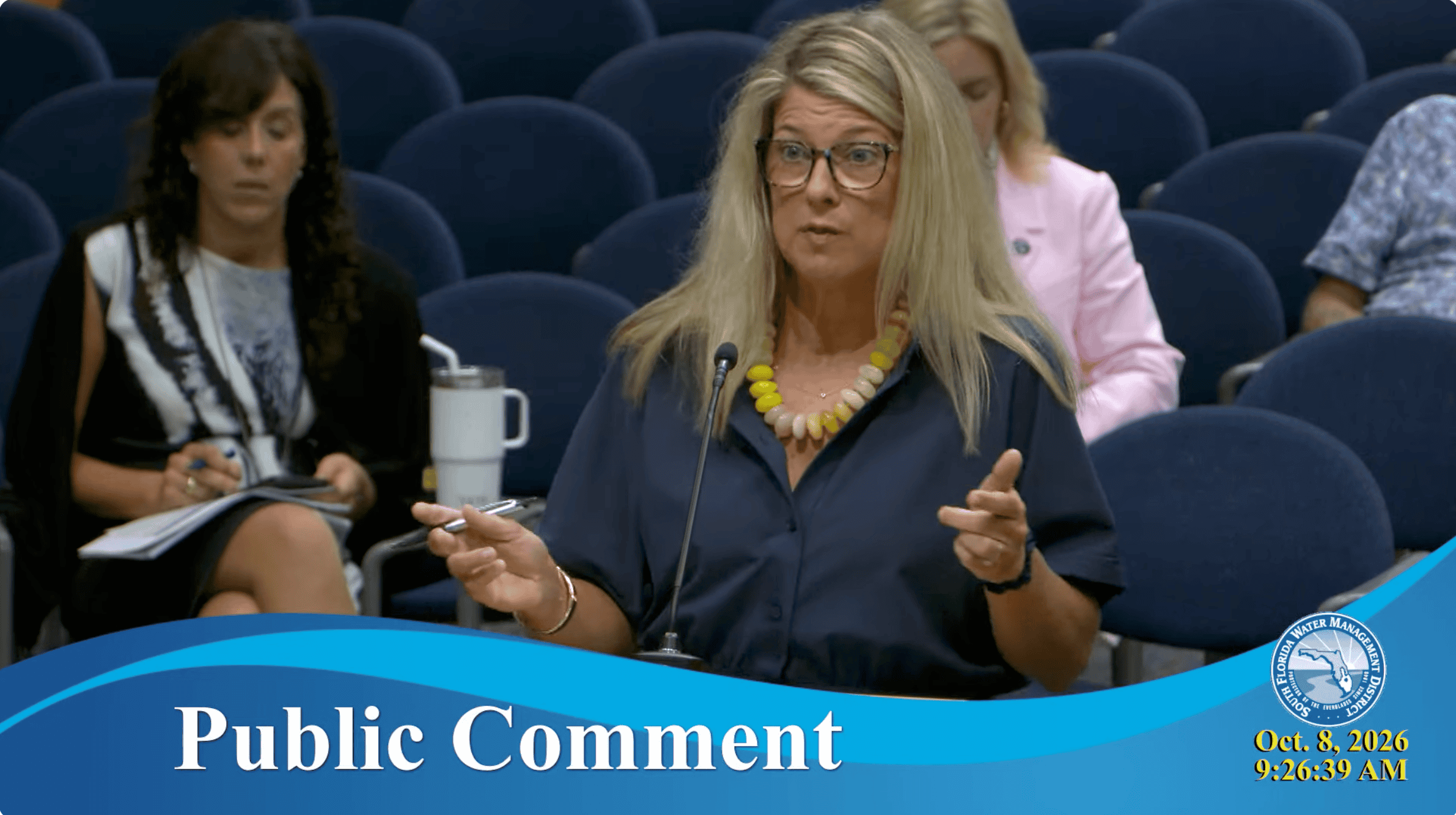
Our message was straightforward: these circumstances warrant serious scrutiny at the highest level of the District.
During the meeting, Governing Board members acknowledged concerns about the application, and there was discussion of bringing the dewatering permit before the Board rather than leaving its review solely at the staff level.
That's an important development, and we'll be following closely to ensure that additional oversight takes place.
But this issue goes beyond a single permit.
The bigger question: What is Southland really building?
We support water storage. In fact, building more storage, paired critically with treatment and designed to benefit the broader Everglades ecosystem, is central to the restoration effort we've been fighting for over the past decade.
That's precisely why the EAA Reservoir matters so much.
But a privately developed water-storage proposal attached to a massive limestone mine is not automatically an Everglades restoration project.
And calling something a water-resource project doesn't make it one. We've been calling this thing out for the pig that it is since day one, because it just never smelled quite right. But the interests behind it just keep adding more lipstick and hoping the public will stop paying attention.
Southland's backers have had years to explain the public benefits of their proposal. Yet the clearest, most detailed plans now emerging involve mining, excavation, dewatering, aggregate processing, and rail transportation.
Meanwhile, the questions surrounding water-resource benefits, potential impacts to adjacent restoration projects, and the use of taxpayer dollars continue to grow.
The District's next deadline for Southland's revised water-resource proposal is December 1, 2026.
We'll be watching closely.
Because when a massive private mining operation is proposed just 1,000 feet from one of the most important Everglades restoration projects in history, Florida deserves more than promises. It deserves answers, transparency, and accountability.
We'll continue investigating these developments, raising concerns with decision-makers, and keeping the public informed as this proposal moves forward.
After repeated delays, a massive new mining-related permit application, and a proposed $5.9 million taxpayer-funded rail extension, serious questions are mounting about Southland's so-called water-resource project.
For more than two years, Big Sugar and the interests behind the proposed Southland Rock Mine have been selling the project as a solution for Florida's water challenges. They've promoted its potential water-storage benefits, suggested it would complement Everglades restoration, and assured the public that the project wouldn't strain public resources.
But the deeper we dig into the records, the harder those claims are to reconcile with what's actually happening.
In just the past few weeks, Southland has received yet another extension to answer fundamental questions about its supposed water-resource benefits, submitted a detailed application for long-term dewatering associated with mining operations, and been named in a $5.9 million intended state grant award for railroad infrastructure.
All while proposing a massive mining operation right next to one of the most important Everglades restoration projects in history.
So what's really going on?
First, a quick refresher: What is Southland?
The Southland proposal involves approximately 8,600 acres of agricultural land owned by interests associated with U.S. Sugar and Florida Crystals, immediately adjacent to the Everglades Agricultural Area (EAA) Reservoir and Stormwater Treatment Area.
The project is being advanced by Phillips and its affiliates, under the premise of creating a privately developed water-storage project.
But there's another major component: excavating, aka mining, enormous quantities of limestone, processing that material, and transporting it out by rail.
And the location couldn't be more concerning.
Southland sits roughly 1,000 feet from the $4 billion EAA Reservoir project currently under construction, the crown jewel of Everglades restoration. For perspective, that's roughly the distance a skiff traveling at 30 mph would cover in just 23 seconds.
The EAA Reservoir is designed to capture excess water from Lake Okeechobee, clean it through an adjacent treatment area, and send more clean freshwater south to the Everglades and Florida Bay. It's a critical piece of a decades-long effort to restore the natural flow of water through South Florida.
Placing a massive industrial mining operation next door raises serious concerns about potential impacts to that investment.
The U.S. Army Corps of Engineers has already raised concerns about seepage and how mining activities could affect the nearby reservoir and treatment area.
Yet Southland's backers continue to promote the project as a beneficial addition to Florida's water-management system.
Here's what the latest records tell us.
1. They call it a water-resource project. So why can't they answer the water-resource questions?
When the South Florida Water Management District (SFWMD) began evaluating Southland's unsolicited water-resource proposal, it requested information necessary to determine whether the project could actually deliver the public benefits being promised.
Those questions involve fundamental issues like water-storage capacity, water quality, public benefits, and potential impacts to surrounding water resources.
That was back in April 2025.
Since then, Southland's backers have repeatedly asked for more time to provide the information.
Four extension requests, totaling approximately 461 days of additional time.
The latest request came recently on September 25, 2026. Three days later, the District granted another extension, pushing the deadline to December 1.
Nearly two years after the current proposal was submitted, the District is still waiting for the revised information it needs to complete its evaluation of the water-resource component.
View this post on Instagram
But here's where things get interesting.
Just one day after that latest extension was granted, Southland filed an entirely separate application with the District.
This time, the plans were remarkably specific.
On September 29, Phillips submitted an application for a long-term dewatering permit. The accompanying technical memorandum explicitly identifies the purpose as facilitating "mining and mitigation."
The application outlines:
- Pumping capacity of up to 45.36 million gallons of water per day for the primary dewatering operation.
- Plans to lower the water table by as much as 10 feet in the primary dewatering area.
- A requested permit extending through December 2039.
- Detailed schedules for excavation, blasting, rock crushing, processing, rail infrastructure, and mining operations.
To put that pumping capacity into perspective, 45 million gallons is roughly the equivalent of an Olympic-sized swimming pool every 21 minutes.
And this is proposed immediately adjacent to a multibillion-dollar Everglades restoration project.
So, the contrast between what Southland says and what Southland does is getting harder to ignore.
While they continue requesting extensions to explain how the project will deliver public water-resource benefits, their mining-related plans are laid out in extraordinary detail.
Two Very Different Stories.
Why does the mining side appear ready to move forward while the supposed public water-resource benefits remain unresolved?
And if the proposed water-storage component never materializes, what happens to the mine?
Those are questions the public deserves answers to.
2. They said the project wouldn't strain public resources. Now there's a $5.9 million state grant in the picture.
From the beginning, Southland's backers have emphasized the privately funded nature of their proposed project.
Among the assurances offered was that the project would be developed without straining public resources.
But a recently uncovered document raises serious questions about that promise.
On September 24, 2026, the Florida Department of Transportation issued a Notice of Intended Grant Awards, identifying South Central Florida Express and Phillips Heavy Civil as recipients of a proposed $5.9 million award for the Southland Rail Extension.
In other words, public funding for rail infrastructure associated with moving the material produced by the proposed mining operation.
The notice is an intended award, not confirmation that funding has already been disbursed. But it establishes that the project was selected for a proposed multimillion-dollar state grant.
That creates an obvious question:
If Southland was supposed to move forward without straining public resources, why is taxpayer funding now being sought for infrastructure associated with its mining operation?
There's also a broader issue worth examining.
The proposed water-storage component remains under District evaluation, yet state transportation funding has already been proposed for infrastructure supporting the movement of aggregate.
Once again, the mining-related components appear to be moving forward while the supposed public water benefits remain uncertain.
And the $5.9 million rail award could be just the beginning. That's basically just money for the driveway to the project. Who knows how much more taxpayer funding they will seek for the actual project?
View this post on Instagram
View the FDOT September 24 Notice of Intended Grant Awards
3. They say the project will complement Everglades restoration. The Army Corps has raised serious concerns.
Southland's backers have repeatedly presented the project as complementary to Everglades restoration, with assurances that its mining activities would not negatively affect nearby restoration infrastructure.
But federal water managers have raised significant concerns.
Construction of the EAA Reservoir.
In July 2025, the U.S. Army Corps of Engineers acknowledged concerns about the proposal, including the possibility that seepage associated with mining activities could affect the EAA Reservoir and its adjacent Stormwater Treatment Area.
Those concerns are especially relevant now.
Southland's newly submitted dewatering application proposes lowering groundwater levels during construction activities immediately north of the A-2 Stormwater Treatment Area.
The applicant's technical analysis concludes that the potential for certain off-site impacts is minimal, citing site hydrology, existing canals, and proposed water-management measures.
But those conclusions need thorough independent scrutiny, particularly given the proximity to federally authorized restoration infrastructure.
We're talking about billions of public dollars invested in a project designed to restore the Everglades, reduce damaging Lake Okeechobee discharges, and protect Florida's coastal communities.
The risks are too significant to simply accept assurances at face value.
We took these concerns directly to the Governing Board
On October 8, Captains For Clean Water brought these latest developments directly to the South Florida Water Management District's Governing Board.
Two members of our team spoke during the meeting, raising questions about the repeated extensions, the new dewatering permit application, and the disconnect between Southland's detailed mining plans and its still-incomplete water-resource proposal.
Our message was straightforward: these circumstances warrant serious scrutiny at the highest level of the District.
During the meeting, Governing Board members acknowledged concerns about the application, and there was discussion of bringing the dewatering permit before the Board rather than leaving its review solely at the staff level.
That's an important development, and we'll be following closely to ensure that additional oversight takes place.
But this issue goes beyond a single permit.
The bigger question: What is Southland really building?
We support water storage. In fact, building more storage, paired critically with treatment and designed to benefit the broader Everglades ecosystem, is central to the restoration effort we've been fighting for over the past decade.
That's precisely why the EAA Reservoir matters so much.
But a privately developed water-storage proposal attached to a massive limestone mine is not automatically an Everglades restoration project.
And calling something a water-resource project doesn't make it one. We've been calling this thing out for the pig that it is since day one, because it just never smelled quite right. But the interests behind it just keep adding more lipstick and hoping the public will stop paying attention.
Southland's backers have had years to explain the public benefits of their proposal. Yet the clearest, most detailed plans now emerging involve mining, excavation, dewatering, aggregate processing, and rail transportation.
Meanwhile, the questions surrounding water-resource benefits, potential impacts to adjacent restoration projects, and the use of taxpayer dollars continue to grow.
The District's next deadline for Southland's revised water-resource proposal is December 1, 2026.
We'll be watching closely.
Because when a massive private mining operation is proposed just 1,000 feet from one of the most important Everglades restoration projects in history, Florida deserves more than promises. It deserves answers, transparency, and accountability.
We'll continue investigating these developments, raising concerns with decision-makers, and keeping the public informed as this proposal moves forward.